Why Convertible Notes and SAFEs are Extra Dilutive

Background Reading:

Outside of Silicon Valley, Convertible Notes are the dominant form of seed round security. In SV, SAFEs are much more popular. The difference between the two effectively amounts to interest and a maturity date. For larger seed rounds, however, seed equity is another possibility.

The point of this post is not to debate the pluses and minuses of any of the above structures. The optimal one is, as mentioned in the above-linked posts, highly contextual. However, founders should understand that while SAFEs and Notes are faster and simpler to close on (usually), they come with a cost in the form of extra dilution relative to doing a seed equity round at an equivalent valuation. The math is as follows:

Dilution when raising seed as equity

Pre-Seed Capitalization:
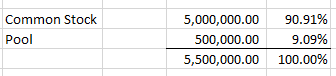
You want to raise a seed round with the following terms:

  • Round size: $1.5 million
  • Valuation (cap or pre-money if equity): $6 million

You end up doing a seed equity round, with a 10% post-money pool, but with the pool top-up added to the pre-money (as it usually is). Post-close capitalization looks like:
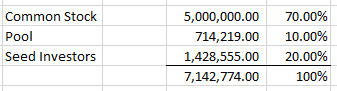
Key to understanding what’s going on here is how the Seed Equity price gets calculated. $6 million (valuation) / (5MM Common + 714,219 pool) = $1.05.  So the seed investors paid $1.05 per share for their shares.

A year or two pass, and it’s time to do a Series A. The Series A economic terms are:

  • Round Size: $2.5 million
  • Pre-money: $10 million
  • Post-Close Available Pool: 15%

After you do the deal math (explaining that is not the point of this post), the post-close cap table looks like this:
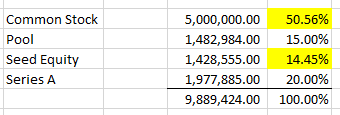
So the above is what dilution looks like after both (i) a seed equity deal of $1.5MM at a $6MM pre with a 10% post-close available pool and then (ii) a $2.5MM Series A at a $10MM pre with a 15% post-close available pool.

Dilution when raising seed as convertible notes or SAFEs

Now let’s replay the above steps, except instead of doing an equity round for the seed, let’s do a convertible note or SAFE round. We can ignore interest, which economically makes the SAFE and Note scenario exactly the same.

Pre-Seed Capitalization:

OK, now we do a $1.5 million convertible note or SAFE with a valuation cap of $6 million. Same numbers as the above seed round, except it’s structured as a convertible security instead of an equity round.

Because these are notes or SAFEs, there’s no dilution registered yet on the cap table. The dilution math is deferred until the Series A.

So after closing the $1.5MM, we’re now at the Series A round. Because we have notes/SAFEs, we’re required to do two calculations in this round: first we calculate the conversion price of the SAFE/Note seed round, and then we calculate the price of the Series A.

Repeating the terms of the Series A:

  • Round Size: $2.5 million
  • Pre-money: $10 million (VCs insist Note shares go in pre-money to keep their post-close % at 20%)
  • Post-Close Available Pool: 15%

After we run through the deal math, this is what the cap table looks like:
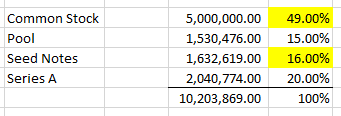
The conversion price for the Note/SAFE is calculated by $6MM (valuation cap) / (5MM Common Stock + 1,530,476 Pool) = $0.92.

Now let’s compare the Post-close Series A cap table between the Seed Equity v. the Seed Note/SAFE scenarios.

Seed Equity –> Series A:

Seed Note/SAFE –> Series A:

What’s different? The Series A got the exact same ownership, because that’s how VC’s approach deal math. They will adjust the numbers to ensure they get their %. However, the Common Stock has 1.56% less ownership, all of which went to the Seed round. And the reason for that is straightforward, the Seed got a lower price, because the larger pool (post-A instead of just post-Seed) was built into their conversion math. 

In this scenario, 1.56% is about $195K in Series A post-money terms. So the decision to do seed SAFEs/Notes instead of seed equity cost the common stock nearly $200K in Series A dollars. And that’s ignoring interest, which would put that past $200K if we’re talking convertible notes with interest. I also simplified the example by ignoring actual usage of the pool in-between rounds. A real-world example would’ve had a larger pool top-up at Series A, and therefore a larger dilution gap between seed equity and notes/SAFEs.

Conceptually the way to view this is that convertible notes/SAFEs, as currently structured, have a kind of strong anti-dilution protection built into them. And that’s apart from the more obvious anti-dilution aspect relating to valuation: that a valuation cap is just a cap, and the notes will convert at a lower price if your Series A is below the cap.

If I do a seed equity round, everything that happens to the capitalization afterward dilutes everyone, including the seed equity. There is a conventional form of (soft) anti-dilution protection (typically broad-based weighted average) in seed equity, but it is rarely triggered; only in down-round scenarios. When the Series A bargain for a larger pool and put that pool in the pre-money, the seed equity doesn’t benefit from it because their math already happened.

But in the note/SAFE scenario, the seed math is deferred to the Series A round. Anything that happens to the capitalization before that date gets built into the seed note/SAFE conversion math, so they’re protected from it. This is why the seed notes/SAFEs end up paying a lower price (92 cents) instead of the higher seed equity price ($1.05). The denominator in calculating their math is larger because of the larger pool. Lots of founders think that SAFEs/Notes only have harsh anti-dilution economics if there’s a “down round.” But that’s not entirely true. The scenario I described above was not a down-round scenario. SAFEs/Notes protect investors from dilution, much more so than seed equity, in every scenario.

If companies and investors, and in the case of SAFEs, Y Combinator, wanted to really make SAFEs and Notes more equivalent in economics to seed equity, they would allow for the capitalization, for purposes of calculating the conversion price, to be set in the security. In other words, at the time of issuing the SAFEs/Notes, we would say the capitalization is X, and that is the capitalization we will use for purposes of determining the conversion price, regardless of what the Series A negotiate for their option pool adjustment. That would not be hard to do at all.  The valuation would still float and be determined at Series A, as is part of the core “deal” of a convertible security, but that full anti-dilution aspect of SAFEs/Notes would be removed.

I have rarely seen this solution actually implemented in the market. Why? I’m not sure. A lot of people aren’t even aware of this economic disconnect between SAFEs/Notes and Seed Equity, so it could just be lack of awareness. Hopefully this post helps with that.  But it’s also possible that it’s just part of the “deal” that investors expect for taking convertible securities. If you ask them to move fast and take minimal protections/rights in exchange for their money, part of the price is extra dilution.

Whether or not founders think that price is fair will obviously depend on the circumstances of their company.  The goal of this post was not to give an opinion on SAFEs v. Notes v. Seed Equity, because my opinion is that they are all good for different circumstances. They all have their positives and negatives. All I wanted founders to understand is that there is an economic price to using SAFEs/Notes. Make sure it’s really worth paying.

Angel Investors v. “Angel” Investors

TL;DR: The term “angel” investor has connotations that in reality don’t apply to a significant portion of early-stage seed investors outside of Silicon Valley. Historically, angel investors were very wealthy individuals who’d take big, almost irrational (from a risk-adjusted perspective) bets on entrepreneurs for reasons that go well-beyond a profit motive. Many “angels” that you’ll encounter as an entrepreneur, however, think and act in a much more self-interested, conservative manner; much like venture capitalists, but with smaller checkbooks. Both types are crucial to startup ecosystems, but knowing the difference is still important.

Related Reading:

One of the core reasons behind this blog’s existence is that the majority of legal/fundraising advice available to startup entrepreneurs comes from places (like Silicon Valley or NYC) that are dramatically different (in terms of access to capital and key resources) from the environments in which most tech entrepreneurs find themselves. That doesn’t mean at all that SV or NYC advice is bad or wrong. On the contrary, much of it is very very good and founders who look only to local advice will screw themselves – see: The Problem with Localism. But founders also need to understand the mismatches between the advice/culture they’re exposed to on the most popular podcasts, blogs, etc., and how things tend to work for normals.

One important area where I see the disconnect arise is in founders’ expectations in interacting with “angel” investors. The typical “angel” investor that you encounter in Austin, Houston, Atlanta, Dallas, or Miami does not look, think, or act like what Silicon Valley people have historically referred to as “Angels.” 

Classic Angels

While the full origin of the term “angel” investor goes beyond this post, in general very early stage investors were very wealthy individuals who, in addition to other activities, wanted to “give back” to the business community by making bets on promising entrepreneurs that no one else (rational) would be willing to make. Hence, their investments were “angelic.” While this doesn’t mean at all that Angels didn’t scrutinize their investments, or that that they acted completely out of charity (hardly), the term absolutely has (correct) connotations of motives that are much broader than just making a great return.

These classic “Angels” were wealthy enough that writing a $100K or $200K+ check barely moves their needle, and so they could take the risk of investing in a company with little more than a very promising team and an idea, and perhaps the very early beginnings of a product. If it fails, NBD. They’re doing it for the relationships, the excitement, and the chance at supporting something new.  I often see founders take very early money from investors that fit the classic “Angel” profile, but those relationships take a long time to build. They don’t spark over a pitch contest or business plan competition.

Anyone who says there isn’t enough money in Texas/the South is painting with way too broad of a brush. There’s tons of money floating around here and elsewhere. The core difference is that in Silicon Valley, the true capital-A “Angel’ money was created in tech, and therefore much more easily flows back into early-stage tech (because the Angels trust their judgment on tech teams/companies). Outside of that environment, much of the ‘Angel’ money comes from other industries (like Energy, Healthcare, etc.), and so much more relationship-building, selling, and (cultural) translation is needed to convince it to go into a tech startup.  Great t-shirts and a pitch deck won’t get you there.

Most “Angels”

In most other tech ecosystems (outside of SV), when people speak of “angel” investors they are often talking about successful individuals who, while willing to take on the risk of early-stage seed investment (which is great), are not so wealthy and altruistic that they’ll barely feel losing $100K-$200K.  That means that most “angels” seen in non-SV ecosystems are much more conservative in how they pick their investments (and will therefore have higher expectations), because to many of them angel investing really is about making a great financial return.

Classic Angel investors were/are generally very wealthy senior executives and business people with net worths well into 8 figures and above, who will bet on team, vision, and minimal traction (if any); so very early stage. The majority of “angels” that entrepreneurs encounter in their own ecosystems, however, come from broader backgrounds (lawyers, doctors, real estate, business owners, etc.) and are affluent/comfortable, but not quite the 0.1% (their angel investments are material to them), and they”ll often want to see clear customer traction, revenue, and a more mature product; and a lower valuation. 

Of course, there are far more “angels” than Angels, so I’m not suggesting at all that the more conservative, self-interested nature of typical “angel’ investors is bad or a problem. They are crucial to startup ecosystems. I’m not running around writing $100K checks on team+vision either. But the distinction between the two categories often gets lost on first-time entrepreneurs, with negative consequences.

You likely need a Pre-Angel Plan

So the net result of the above is that tech entrepreneurs outside of the most dense ecosystems like SV and NYC encounter much higher expectations from “angels,” and therefore (and I’ve written this in prior posts) pre-angel money, what is typically called “friends and family” money, is often essential to building something attractive to “angels.” If I encounter a founder team planning to start a company without a viable path to $50K-$200K in initial funds, either from their own savings, friends and family, or a classic Angel, that is very often a red flag. Not game over, but it is a concern. 

It’s certainly been done before, especially when the founder team is very self-contained and willing to work for nothing until there is real traction, but most companies will never make it to the “angel” investment stage (product, traction, revenue) without either bootstrap/F&F funds, or a classic Angel investor willing to make a big bet. Accelerators have helped with this issue by (often) being the first non-F&F money in and serving as a valuable signal to “angels”, and they deserve credit for that, but even getting to a point where you’re attractive to a top accelerator often takes some real cash.

In short: most angel investors are much more conservative, and have higher expectations, than the term “angel” suggests, because they’re in a different category from the classic wealthy “Angel” investors that give the term its meaning. Be mindful of that fact, and prepare for it in your early-stage fundraising strategy.

Did you get a “good” valuation?

TL;DR: What a “good” valuation is depends highly on context: geography, industry, timing, size, team experience, value-add of money, control terms, and a dozen other variables. Be careful using very fuzzy guidelines/statistics, or anecdotes, for assessing whether you got a good deal. The best valuation for your company is ultimately the one that closes.

VC lawyers get asked all the time by their clients to judge whether their financing terms are good, fair, etc; especially valuation. And that’s for good reason. There are very few players in ecosystems who see enough volume and breadth of deals to provide a truly informed assessment of a financing’s terms. Executives have usually only seen their own companies. Accelerators see only their cohort’s. Most advisors/mentors have even more limited visibility.

But VC lawyers/firms with well-established practices see deals that cross geographic, industry, stage, etc. boundaries.  In addition to a firm’s internal deal flow, there are third-party resources that can be subscribed to with data on VC valuations across the country and the world. Those resources tend to be expensive (5-figure annual subscriptions), and only firms with deep VC practices will pay for them. Given how much you’ll be relying on your lawyers for advice on your financing terms (for the above-mentioned reasons), ensuring that they are objective (and not biased in favor of your investors) is crucial. 

The above all being said, founders should understand that determining valuation at the early stages of a company (seed, Series A, B) is far far more an art than a science. It is for the investor making the investment, and it is for the people judging whether the terms are “good.” That’s why relying on broad metrics like “median Series A valuation is X” is problematic; there are simply too many variables for each company that could justify deviating from the median, in either direction (lower or higher).

What some people call a seed round, others might call a Series A. Some companies raise a Series A very early on in their company’s history because the nature of their product requires serious capital expense to even get to early milestones. Other companies bootstrap for a decade and only use a Series A as true growth capital (the way others would use a Series C or D). I saw a $150MM ‘Series A’ once. I’ve also seen $500K ‘Series A’s. And everything in between as well. So whenever someone asks me “what’s a good Seed or Series A valuation?” the answer has to start out with: “it depends.” 

Below is a break-down of the mental analysis that I might use in assessing a company’s valuation. Remember, it is an art, not a science. There are widely varying opinions here, and this is just one of them. Consider it a set of suggested guidelines, not rules.

1. What was the last valuation a professional investor was willing to pay, and what progress has been made since then?

The easiest answer to “what is X worth?” is “whatever price someone was willing to pay.” While not entirely helpful in the VC context, it certainly is relevant. If you’re doing a Series A and you have institutionals who invested in a convertible note at a $5MM cap a year ago, the obvious question then is “how much progress has been made since then?” This, btw, is why it’s dangerous for companies to set their own valuations without a true market check from professional investors. Your earlier valuations will influence your later ones.

2. What city are you in?

Location. Location. Location. One of the strongest determinants of valuations is the density of startup capital in the city your company operates in; because density means competition. Silicon Valley valuations are not 2-3x those of the rest of the country because the VCs there are just nice guys who are willing to pay more. It’s a function of market competition. SV has the highest valuations. NYC follows. And then there’s the rest of the country, with variations by city. Austin valuations are generally higher than Atlanta’s, which are generally higher than Houston’s or Miami’s. General deal terms are also more company-friendly where there is more investment density.

While the entire concept of “founder friendly” investors does have an important moral/human dynamic to it, people who play in the space enough know that at some foundational level it is a form of self-interested brand differentiation. The ‘friendliest’ investors are the ones in the most competitive, transparent (reputationally) markets. Why take our money over theirs? Because we’re ‘founder friendly’… which can mean a whole lot of things; some of which are relevant, and others which are nonsense.

Yes, online networks are breaking down geographic barriers and you are seeing more capital flow between cities/states, but the data is still crystal clear that if a Silicon Valley VC is investing in an Atlanta or Austin company, they are going to want to pay something closer to Atlanta or Austin (not SV) prices. Much like all the Ex-Californians buying up Austin homes, they likely will pay slightly above the local market (and in both cases, it pisses off local buyers), but not much. 

3. How much is being raised?

Valuations can (and often do) vary widely between markets, while the actual dilution that founders absorb doesn’t vary as much. How is that? Because founders in markets with higher valuations raise larger amounts of money, and founders in markets with lower valuations raise smaller amounts of money; in each case getting the VCs/investors to their desired %. A $1MM raise at a $4MM valuation produces the same dilution as a $5MM raise at a $20MM valuation.

You should never close any round without modeling (lawyers often help here) the actual dilution you are going to absorb from the round, including any changes required to your option pool. Many investors focus first on their desired % and then back into the right valuation and round size. Smart founders should focus on %s as well. It’s not intuitive; especially if you have multiple rounds involved.

4. Who are the investors?

Value-add, known-brand institutional VCs and professional angels that will be deeply engaged in building your company after the check hits are (obviously) worth a lot more than investors who just bring money. And they will often price themselves accordingly (lower valuations). Some money is greener.

Diligencing the valuations your specific investors were willing to pay for their past investments is a smart move. Again, it still requires discussions about the differences between companies, but it can help address any statements like “we never pay more than $X MM for Series A.”

5. What are the other terms?

A $4MM valuation with a 1x non-participating liquidation preference looks very very different in an exit from a $6MM valuation with a 2x participating liquidation preference. So does a $3.5MM valuation with investors getting 1 out of 3 Board seats v. a $5MM valuation with them getting 2/3. The non-valuation terms matter. A lot. Juicing up valuations by accepting terrible ‘other’ terms gets a lot of companies in trouble. 

6. Other Business-Focused Variables

  • What are valuations within this specific industry looking like over the past 12 months?
  • What are the obvious acquirers paying for companies they buy?
  • Where is the company in terms of revenue? Revenue-multiples generally don’t have a place in early-stage, but a $25K MRR v. $300K MRR absolutely influences valuation.
  • Any serial entrepreneurs on the team? Good schools? Other de-risking signals?
  • What’s growth look like?
  • Size of market?
  • etc. etc. etc.

Obviously, multiple term sheets are a great way to have a very clear idea of where your valuation should be, but in most non-SV markets that is a privilege bestowed on a small fraction of companies.

Take-homes:

A. If your friend’s startup got X valuation for their Series A round, that can be totally irrelevant to what valuation you should get,

B. Other terms of the financing matter a lot too, as well as who is delivering them, and

C. If you have in your hand a deal that isn’t exactly at the valuation you wanted, remember that there are thousands of founders out there who got a valuation of $0.

Over-optimizing for valuation can mean under-optimizing on a host of things that matter far more for building your business. Get the best deal that you can actually get, given your business, location, and investors, and then move forward. And ignore the broad market data, particularly the Silicon Valley data, that isn’t relevant to your own company.